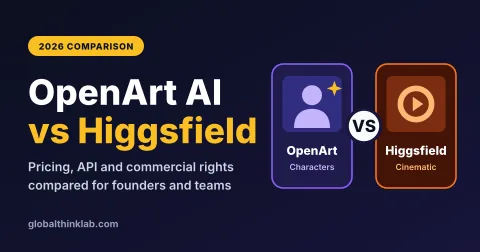
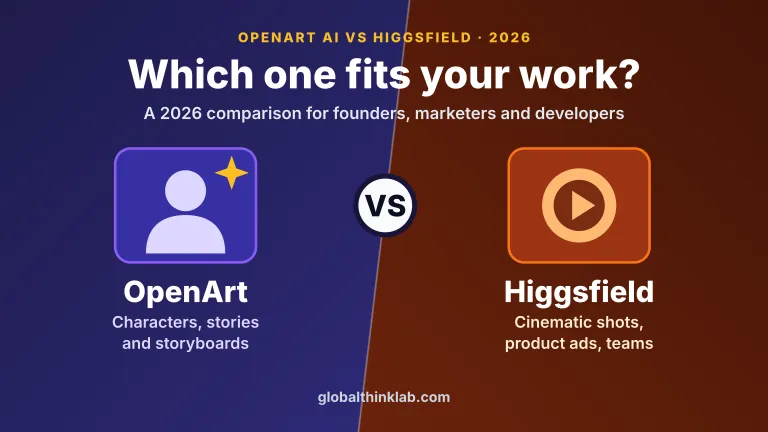
OpenArt AI vs Higgsfield is not a contest of image quality. Both platforms resell many of the same frontier image and video models, so the real differences sit in pricing, automation and legal terms. Higgsfield suits teams, agencies and cinematic ad work. OpenArt suits solo creators who build recurring characters and story-led videos. This guide compares the two as of November 2026, covering plans, commercial rights, API access, team features and a verdict by reader type. Prices and terms change often, so check each number on the vendor’s page before you buy.
Quick Verdict
The short answer
- Choose Higgsfield for cinematic ad shots, product ads from a URL, team workspaces, automation and handing finished files to clients.
- Choose OpenArt for reusable characters, storyboards and story-led videos, or when a client contract says your data must never train an AI model.
- Model quality will not settle it. Both give you access to many of the same third-party models.
- Read the terms before paying. Commercial rights and training rules differ by plan on both sites.
| Question | OpenArt | Higgsfield | Edge |
| Built around | Characters and stories | Shots and production | Depends on your work |
| Public API | Unconfirmed | Yes, separate developer product | Higgsfield |
| Commercial use | From the Plus plan up, per its terms | Paid plans, per its terms | Higgsfield (simpler) |
| No-training promise | Stated for Enterprise | Enterprise Agreement only | OpenArt |
| Team tools | Team, Business, Enterprise | Team, Scale, Enterprise | Higgsfield |
| Free way to try | 40 trial credits | Limited free tier | Tie |
What OpenArt and Higgsfield Are Built For
Both tools describe themselves as creative platforms. They lean in different directions.
OpenArt positions itself as an all-in-one space for characters, stories and videos. Its standout tools are narrative ones. Character Builder creates a reusable character from reference images, a description or a step-by-step builder. Smart Shot plans a scene from reference images and shows a storyboard before you generate. Story templates cover formats such as music videos and character vlogs. OpenArt’s enterprise page cites access to 100+ models under one subscription.
Higgsfield positions itself as a creative suite for production. Cinema Studio gives you camera, lens and lighting control with multi-shot scenes. Marketing Studio builds product ads and UGC-style clips from a product URL or image. Soul ID and AI Influencer keep a character consistent across clips. Canvas is a node-based board that chains models into one workflow you can save as a template. Higgsfield lists 30+ models through its MCP server.
In short: OpenArt is built around the creator and the story. Higgsfield is built around the shot and the production line.
OpenArt AI vs Higgsfield: Feature and Use-Case Comparison
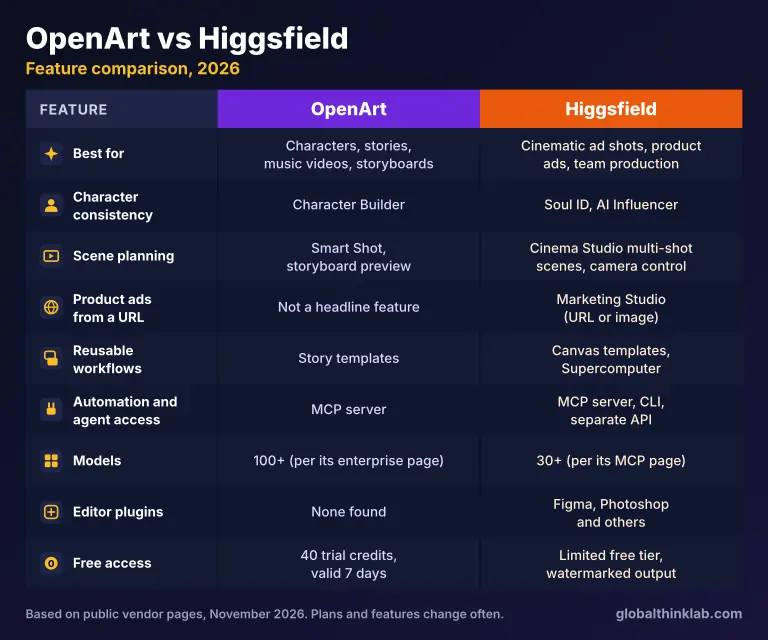
| Feature | OpenArt | Higgsfield |
| Best for | Characters, stories, music videos, storyboards | Cinematic ad shots, product ads, team production |
| Character consistency | Character Builder | Soul ID, AI Influencer |
| Scene planning | Smart Shot, storyboard preview | Cinema Studio multi-shot scenes, camera control |
| Product ads from a URL | Not a headline feature | Marketing Studio (URL or image) |
| Reusable workflows | Story templates | Canvas templates, Supercomputer |
| Agent and automation access | MCP server | MCP server, CLI, separate API |
| Models | 100+ (per its enterprise page) | 30+ (per its MCP page) |
| Editor plugins | None found | Figma, Photoshop and others |
| Free access | 40 one-time trial credits, 7 days | Limited free tier, watermarked output |
Sources: openart.ai, openart.ai/enterprise, higgsfield.ai, higgsfield.ai/mcp, November 2026.
Which use cases favour which tool?
- Short films and recurring characters: OpenArt. The Character Builder and Smart Shot are made for continuity across scenes.
- Product ads and UGC-style video: Higgsfield. Marketing Studio starts from a product URL or image.
- Cinematic camera moves: Higgsfield. Cinema Studio puts camera and lighting controls up front.
- Social story formats (vlogs, explainers): OpenArt. Its story templates target these formats.
- Repeatable multi-step jobs: Higgsfield. Canvas saves a chain of steps as a template.
OpenArt vs Higgsfield Pricing in 2026
Plan names, credit counts and prices on both sites have shifted several times this year. Treat every figure below as a dated snapshot and confirm it at checkout.
| OpenArt | Higgsfield | |
| Free | 40 one-time trial credits, valid 7 days; no commercial use | Limited models, no credits, watermark on output |
| Entry paid | Starter, about $13/month | Starter, about $15/month for 200 credits |
| Mid tier | Plus, about 34/month(27 billed yearly); first tier with commercial rights | Plus, about $49/month for 1,000 credits |
| Upper tier | Pro, about $56/month; Wonder, about $240/month ($44,$75 billed yearly )for 106,000 credits | Ultra, about $129/month for 3,000 credits |
| Business | Team and Business plans; Enterprise is usage-based | Team (2 to 9 seats), Scale (5 to 15 seats), Enterprise |
| Credit rollover | Credits reset monthly and do not roll over | Credits reset |
Three things to know before you compare prices:
- Credits are not a shared currency. One credit buys different amounts on each platform, and cost depends on the model, resolution and clip length. Compare the cost of one finished clip, not credits per dollar.
- Higgsfield prices vary by country. Higgsfield says plans and prices adjust to your region, and tax is added at checkout. UK, Canadian and Australian readers may see different numbers from the US figures above.
- “Unlimited” has conditions. Higgsfield’s unlimited access covers specific models for a set period, such as 7 or 365 days, and applies on its website only. More on that below.
Commercial Use, Client Rights and AI Training on Your Data
This is where the two tools differ most for professional work. Each one wins a different clause.
Who can use the output commercially?
Higgsfield says it does not claim ownership of your inputs or outputs and does not restrict commercial use of outputs. Its help center says rights in exported outputs survive cancellation and can be transferred or sublicensed to clients (Terms of Use, section 4.4). Its free tier is the exception: output is watermarked and not cleared for commercial use . [ Higgsfield pricing ]
OpenArt grants commercial use from the Plus plan and above, according to its Terms of Service and its pricing page. Starter and free output is for non-commercial use. OpenArt’s own pages are not fully consistent: a blog post says you can use results in client campaigns and paid ads without naming a plan. The Terms are the binding document, so follow them and confirm your tier in writing. [OpenArt pricing]
Who trains on your content?
OpenArt states on its enterprise page that it does not train on your data. That promise is stated for Enterprise customers. What applies to individual plans is not clear from the public pages reviewed .
Higgsfield‘s terms say your content, inputs and outputs may be used to train and improve its models. Customers on a separate Enterprise Agreement are excluded from training. Deleting your content or account stops future training use, but content already used cannot be pulled out of models that were already trained. Higgsfield revised its terms in mid-2026 after public criticism, and the current version was last updated in October 2026 . Higgsfield AI Review
What this means in practice
- Your risk is a client who calls their product launch confidential: OpenArt’s Enterprise promise is the stronger fit, or negotiate a Higgsfield Enterprise Agreement.
- Your risk is handing finished work to a client who will resell it: Higgsfield’s explicit sublicensing language is clearer.
This is general information, not legal advice. Both sets of terms change, so read the current versions before you sign or deliver client work.
Higgsfield API, MCP and CLI vs OpenArt MCP
Developers and automation-minded teams should read this section closely.
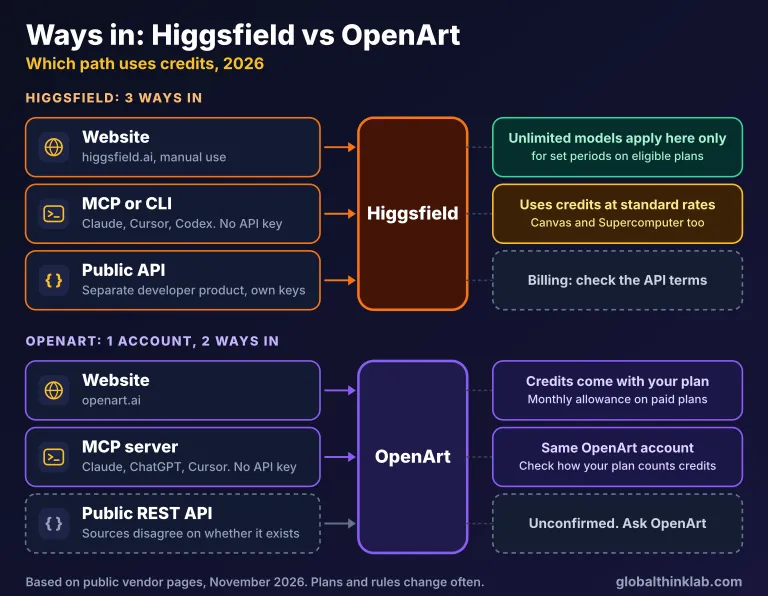
Higgsfield offers three routes. Its MCP server connects through your Higgsfield account with OAuth and needs no API key. Its CLI and Skills package lets coding agents such as Claude Code, Cursor and Codex generate from the terminal. Separately, a REST API with its own keys exists as a developer product .
OpenArt runs an MCP server that works with Claude, ChatGPT, Cursor and other MCP clients. It covers image generation, video, image-to-video, reference images and your library. At the time of the pages reviewed, OpenArt listed Character Builder as not yet available through MCP, and sources disagreed on Smart Shot . Whether OpenArt has a public REST API is unconfirmed: one review says no, and an older guide describes one on the Pro plan .
The “unlimited” catch. Higgsfield states that unlimited generations apply on its website only. Work sent through MCP, CLI, Canvas or Supercomputer uses credits at standard rates. An unlimited plan and an automated pipeline are two separate costs, so price the credit-metered route if you plan to automate.
Team Plans and Collaboration
Higgsfield sells Team (2 to 9 seats) and Scale (5 to 15 seats) plans with credits pooled in one workspace, plus an Enterprise tier with custom pricing, SSO and a data processing agreement . Its help center also describes real-time collaboration inside Canvas and Cinema Studio.
OpenArt sells Team and Business plans on a separate tab of its pricing page. Its Enterprise page describes unlimited seats, usage-based pricing, credits that do not expire, and admin controls over projects, people and spending .
Neither site clearly advertises white-label or reseller options. If you sell AI-made work under your own brand, ask both vendors directly.
OpenArt Pros, Cons and Best-Fit Users
Pros
- Character Builder and Smart Shot suit story-led work with recurring characters.
- A clear no-training promise for Enterprise customers.
- Broad model access (100+ models cited on its enterprise page).
- MCP support for Claude, ChatGPT and Cursor.
Cons
- Commercial use starts at the Plus plan, so entry and free output are non-commercial.
- Public REST API is unconfirmed.
- Credits reset monthly and do not roll over.
- Fewer production-style features, such as product ads from a URL .
Who it’s best for: solo creators, storytellers, music-video makers and small brands that need the same character across many scenes.
Higgsfield Pros, Cons and Best-Fit Users
Pros
- Cinema Studio for camera, lens and lighting control.
- Marketing Studio for product ads and UGC-style clips from a URL or image.
- MCP, CLI and a separate API for automation.
- Team and Scale plans with pooled credits.
- Explicit language on transferring and sublicensing outputs to clients.
Cons
- Default terms allow training on your content unless you hold an Enterprise Agreement.
- “Unlimited” does not apply to automated routes.
- Plans, credits and prices have changed repeatedly in 2026.
- Free output is watermarked.
Who it’s best for: agencies, performance marketers, filmmakers and developers who need shot-level control and automation.
Which Should You Choose? Verdict by Reader Type
| Reader | Pick | Why |
| Solo creator or founder | OpenArt for stories and characters; Higgsfield for ads and cinematic clips | Match the tool to the output. Remember OpenArt commercial rights start at Plus. |
| Small team or agency | Higgsfield | Pooled credits, Canvas templates and clearer client-sublicensing language. Check the training clause against client contracts first. |
| Enterprise | Either, decided by procurement | OpenArt states a no-training promise. Higgsfield offers one through an Enterprise Agreement. Request both vendors’ security documents. |
| Developer | Higgsfield | A separate REST API plus MCP and CLI. Budget for credit-metered use, since unlimited access does not cover automation. |
| Marketer running ads | Higgsfield | Marketing Studio starts from a product URL or image. |
If you can only test one tool this week, test the one that matches your most frequent job, not the one with the longer feature list.
How to Test Both Before You Pay
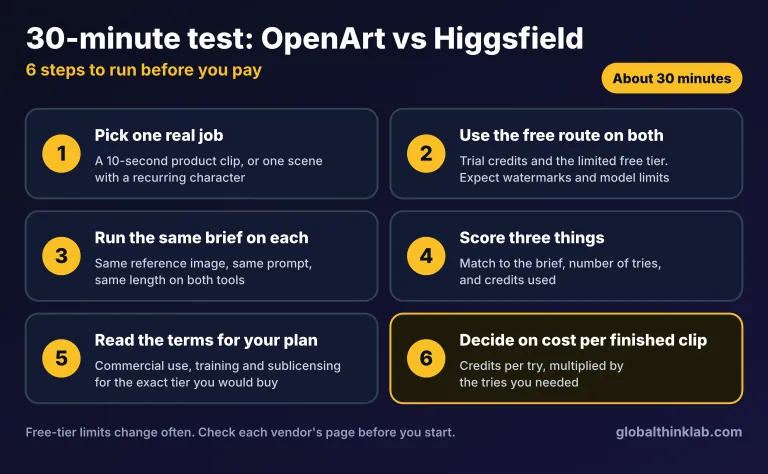
A 30-minute test tells you more than any feature table.
- Pick one real job. For example, a 10-second product clip, or one scene with a recurring character.
- Use the free route on both. OpenArt’s trial credits and Higgsfield’s limited free tier are enough for a first pass. Expect watermarks and model limits.
- Run the same brief on each. Use the same reference image, the same prompt and the same length.
- Score three things. How close the result is to the brief, how many tries it took, and how many credits it used.
- Read the terms for your plan. Check commercial use, training and sublicensing for the exact tier you would buy.
- Decide on cost per finished clip. Multiply the credits per try by the number of tries you needed.
FAQ
Is Higgsfield better than OpenArt AI?
Neither wins on every point. Higgsfield is stronger for cinematic shots, product ads, team plans and automation. OpenArt is stronger for recurring characters, story-led videos and its Enterprise no-training promise. The better pick depends on whether your main job is shot-level production or character-driven storytelling.
Do OpenArt and Higgsfield have an API?
Higgsfield offers a separate REST API alongside its MCP server and CLI. OpenArt offers an MCP server that works with Claude, ChatGPT and Cursor. Whether OpenArt has a public REST API is unclear across sources, so confirm it in OpenArt’s help center before building around it.
Can I use OpenArt or Higgsfield results commercially?
Higgsfield’s terms do not restrict commercial use of outputs on paid plans and allow transfer to clients. OpenArt’s terms allow commercial use from the Plus plan up. Free and entry-level output on both is limited, so confirm your exact plan and read the current terms before using results in client work.
Do OpenArt or Higgsfield train on my content?
OpenArt states on its enterprise page that it does not train on your data. Higgsfield’s terms say content may be used to train its models, except for customers on a separate Enterprise Agreement. Deleting content stops future use on Higgsfield. For confidential client work, check this before uploading anything.
Which is better for agencies and teams?
Higgsfield looks stronger on the published evidence: Team and Scale plans with pooled credits, Canvas templates and explicit client-sublicensing language. Check its training clause against your client contracts, and remember that unlimited access does not cover automated routes such as MCP or CLI.