
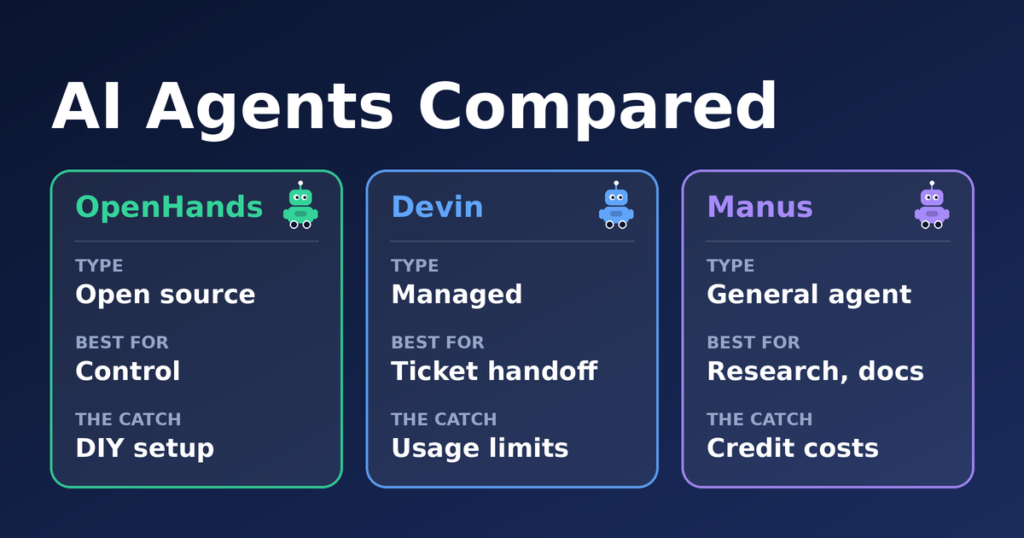
There is no single winner. OpenHands is the best fit if you want an open-source coding agent you control. Devin is better if you want a managed agent that takes tickets and returns pull requests. Manus is a different kind of tool: a general-purpose agent for research, documents, and websites, not a dedicated software engineer.
This guide compares OpenHands AI agent features vs Devin vs Manus on features, 2026 pricing, and use cases, so you can match the tool to your team.
Quick verdict
| OpenHands | Devin | Manus | |
| Type | Open-source coding agent platform | Managed autonomous software engineer | General-purpose autonomous agent |
| Made by | All Hands AI | Cognition | Manus (independent again since Aug 2026) |
| Starting price | Free to self-host; free hosted tier | Free tier; Pro $20/mo | Free tier; paid from $20/mo |
| Best for | Control, model choice, self-hosting | Delegating tickets to parallel agents | Research, slides, documents, sites |
| Main catch | You manage setup and security | Quotas and extra credits can add cost | Credit use is hard to predict |
What these three tools actually are
All three are “agents,” meaning you give them a goal and they work through the steps themselves. The difference is what they are built to do.
OpenHands and Devin are built for software work. They plan a change, write code, run tests, and open pull requests. Manus is built for broader tasks and runs them on its own cloud computer with a browser, terminal, and file system.
That makes a head-to-head comparison imperfect. Comparing Manus to the other two is closer to comparing a Swiss Army knife with two specialist tools.
OpenHands AI Agent Features vs Devin vs Manus
Autonomy and workflow
OpenHands can take a GitHub issue or a task description, then plan and execute the work without per-step direction. Devin 2.0 adds Interactive Planning: it researches your codebase and drafts a plan you can edit before it works on its own. Manus takes a goal and runs the whole task, such as researching a topic and producing a report.
Environment
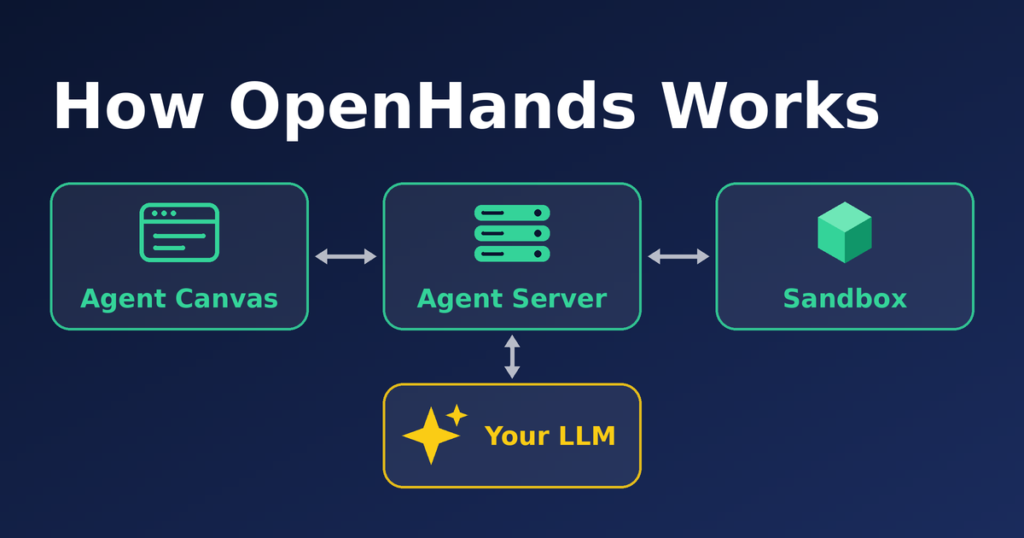
OpenHands runs the agent in a sandboxed Docker environment with a terminal, code editor, browser, and file system. Devin gives each session its own cloud workspace. Manus spins up a containerized Linux environment per session, according to one third-party guide .
Model choice
OpenHands is model-agnostic: you bring your own API key or pay model costs at cost. Devin and Manus are managed services, so you use the models they provide.
Parallel work and team features
Devin lets you run multiple parallel sessions, each with its own cloud IDE, and adds Devin Search and Devin Wiki to explore and document your codebase. OpenHands now ships as Agent Canvas, a browser control center for agent conversations and automations, and it can also run other agents such as Claude Code or Codex. Manus offers a Teams plan with shared billing.
| Feature | OpenHands | Devin | Manus |
| Open source | Yes (MIT) | No | No |
| Self-hosting | Yes | Enterprise only | No |
| Bring your own model | Yes | No | No |
| Parallel sessions | Via SDK and Agent Server | Yes | Yes (plan limits apply) |
| Codebase Q&A / wiki | Not a headline feature | Devin Search and Wiki | Not applicable |
| Documents, slides, sites | No | No | Yes |
OpenHands vs Devin pricing in 2026
Pricing is where guides disagree most, so treat any figure as a snapshot.
Devin. Cognition announced its current lineup on April 14, 2026: Free, Pro at $20 a month, Max at $200 a month, Teams with an $80 monthly minimum and $40 full seats, and custom Enterprise. Many older articles still list a $500 plan or per-ACU billing. Current self-serve plans use quotas and dollar credits, while ACUs now belong to Enterprise contracts.
OpenHands. The open-source version is free under the MIT license, there is a free hosted tier, and Enterprise is quote-only. One review lists the hosted free tier at up to 10 conversations a day. Your real cost is the AI model usage, plus the engineering time to run it.
Manus. Manus is credit-based: a free plan with 300 daily credits, then $20 a month for 4,000 credits, $40 for 8,000, and $200 for 40,000. Credit use varies by task, so heavy jobs can cost far more than light ones.
| OpenHands | Devin | Manus | |
| Free option | Yes | Yes | Yes (limited) |
| Entry paid plan | Self-hosted: model costs only | Pro $20/mo | $20/mo |
| Team pricing | Enterprise, custom | Teams from $80/mo | From $20/seat |
| Cost surprise | Infrastructure and setup time | Overage credits | Credit burn on big tasks |
Open source alternative to Devin AI: where OpenHands fits
OpenHands is the best-known open source alternative to Devin AI. It was previously called OpenDevin and is built by All Hands AI.
The appeal is control. You choose the model, run it on your own machines, and keep code inside your environment. The platform is split into Agent Canvas, a Software Agent SDK, an Agent Server, and OpenHands Cloud for managed hosting.
The trade-off is effort. Someone has to set it up, secure it, and watch costs. One review notes that team features such as SSO and role-based access sit behind custom Enterprise pricing.
One caution: the OpenHands command-line tool has mixed status signals. Its GitHub page says it is no longer actively maintained, while the docs describe it as maintained for stability. Use Agent Canvas for new setups.
Manus AI agent use cases
Manus works best on knowledge tasks rather than code maintenance. A third-party guide lists browser automation, research turned into Word, Excel, PowerPoint, and PDF files, and live website generation as core features.
Practical use cases for marketers and founders:
- Multi-step market or competitor research with a written summary
- First drafts of slide decks and reports
- Simple websites and landing page prototypes
- Repetitive browser tasks, such as collecting data from several sites
A business risk to weigh. Meta announced a $2 billion deal for Manus in December 2025, and Chinese regulators ordered it unwound in April 2026. Manus said in August it would resume independent operations, and some users in certain jurisdictions had data created after the acquisition date slated for deletion. Review current data and compliance terms before using Manus with sensitive work.
Pros, cons, and who each tool is best for
OpenHands
Pros
- Free and open source, with full control over models and hosting
- Runs in a sandbox and works with other agents through Agent Canvas
- An SDK for building custom agent workflows
Cons
- You manage setup, security, and uptime
- Team and governance features need Enterprise
- Product and tooling have changed quickly, so older tutorials may be outdated
Best for: developers and engineering teams who want control, model choice, or self-hosting.
Devin
Pros
- Managed service with parallel sessions and pull request output
- Planning, search, and wiki features for large codebases
- Low entry price for individuals
Cons
- Usage quotas and extra credits can raise costs
- Pricing has changed often, and older guides conflict
- Output still needs human review before merging
Best for: teams that want to hand off well-defined tickets without running infrastructure.
Manus
Pros
- Handles research, documents, slides, and websites in one tool
- Free tier to test with
- Low barrier for non-developers
Cons
- Credit costs are hard to predict
- Not purpose-built for software engineering
- Ownership and data-handling history deserves a review
Best for: founders, marketers, and analysts who need broad task automation rather than a coding agent.
Best autonomous AI software engineer agents 2026: where these three fit
If you are shortlisting the best autonomous AI software engineer agents 2026, two of these three qualify directly: OpenHands and Devin. Manus is better placed in a general AI agent roundup.
The category is crowded. Tools like Claude Code, OpenAI Codex, and Cursor also compete for coding work, so a full buyer’s guide should include them.
Verdict: which should you choose?
- Solo user or freelancer: Start with Devin’s free or Pro tier if you want a managed tool. Choose OpenHands if you are comfortable with setup and want the lowest cost. Choose Manus if your work is research and content, not code.
- Small team: Try OpenHands if one person can own the setup. Otherwise Devin Teams is the easier path.
- Enterprise: Compare OpenHands Enterprise (self-hosted, governance) with Devin Enterprise. Ask both for security documentation. Treat Manus with extra care until data terms are confirmed.
- Developer who wants control: OpenHands. Open source, model choice, and an SDK are the main reasons to pick it.
Whatever you choose, run one real task through a free tier first and judge the result yourself.
FAQ
Is OpenHands a free alternative to Devin?
Largely yes. OpenHands is open source and free to self-host, so your main cost is the AI model you connect to it. It also has a free hosted tier with daily limits. The trade-off is that you run and secure the setup yourself, and team features like SSO sit in the paid Enterprise tier.
How much does Devin cost in 2026?
Devin’s current lineup, announced in April 2026, runs from a free tier to Pro at $20 a month and Max at $200 a month. Teams starts at an $80 monthly minimum with $40 full seats, and Enterprise is custom . Older guides still quote a $500 plan or per-ACU pricing, which no longer applies to self-serve plans.
What is Manus best used for?
Manus suits general knowledge work: multi-step research, building simple websites, and generating slides and documents from a single goal. It runs tasks on its own cloud computer with a browser, terminal, and file system. It is not built specifically for maintaining a codebase, so engineering teams should compare it with a coding agent rather than treat it as a replacement.
Which is best for a small team on a budget?
For most small teams, OpenHands has the lowest entry cost if someone can manage the setup, since you mainly pay for model usage. Devin Teams is the easier managed route, with an $80 monthly minimum. Start with a free tier of either, run one real ticket, and compare the pull request quality before you commit.
Is Manus a safe choice for business data in 2026?
It is worth a careful review. Meta acquired Manus in December 2025, China ordered the deal unwound in April 2026, and Manus said in August it would operate independently again. Some users in certain regions were told to back up data created after December 29, 2025. Check current data and compliance terms before using it with sensitive work .

[…] If you are comfortable in a terminal, Claude SEO is an open-source, completely free toolkit built directly for Claude Code. Updated heavily in 2026, it coordinates up to 17 parallel AI agents to audit your website. “parallel AI agents” […]