The best CodeRabbit alternative depends on what is bugging you about CodeRabbit. If reviews feel shallow, Greptile reads deeper into your codebase. If the bill is the problem, Sourcery, Kodus or self-hosted PR-Agent cost less. If you already pay for GitHub Copilot, its built-in review may be enough. CodeRabbit also changed this year: its plans were restructured in May 2026 and usage-based extras now sit on top of seat pricing. This guide compares eight tools on price, platform support and fit, so you can shortlist two and trial them this week.
Quick Answer: Which CodeRabbit Alternative Should You Pick?
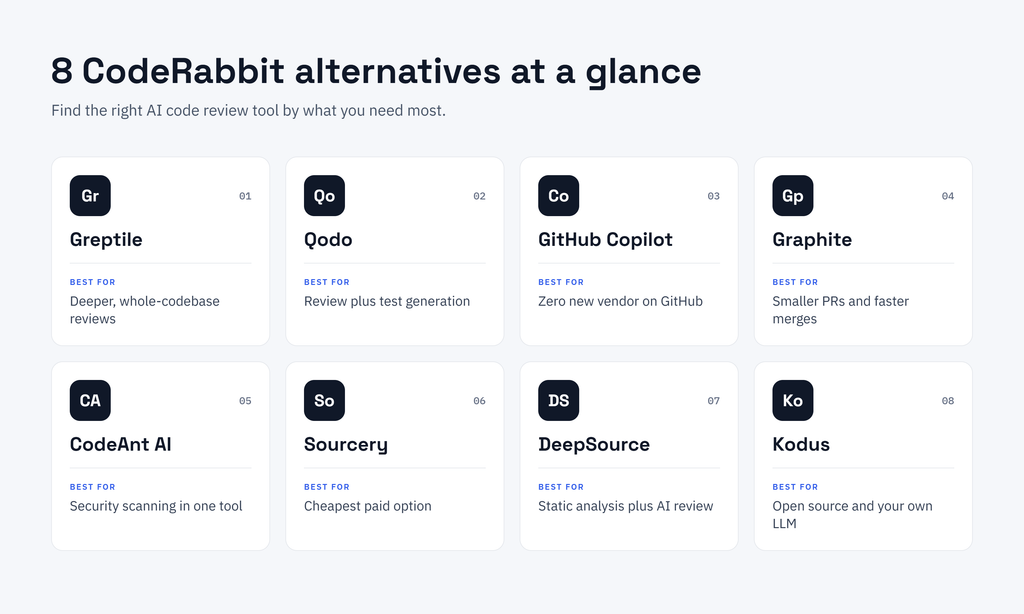
| If you want… | Pick | Why |
| Deeper, whole-codebase reviews | Greptile | Indexes your full repo, not just the diff |
| Review plus test generation | Qodo | Pairs PR review with test suggestions |
| Zero new vendor on GitHub | GitHub Copilot | Review is built into plans you may already have |
| Smaller PRs and faster merges | Graphite | AI review bundled with stacked PRs |
| Security scanning in one tool | CodeAnt AI | SAST plus AI review |
| Cheapest paid option | Sourcery | Lowest listed per-seat price |
| Static analysis plus AI review | DeepSource | Combines linting-style checks with AI |
| Open source and your own LLM | Kodus | Bring your own model key, self-host if needed |
What CodeRabbit Does (and Why Teams Look Elsewhere)
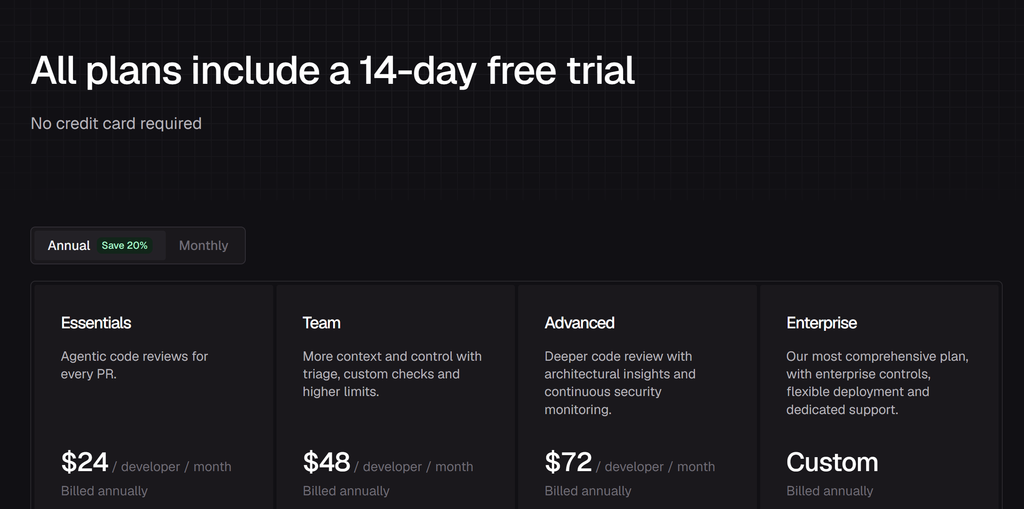
CodeRabbit is an AI reviewer that comments on pull requests with a plain-English summary, line-by-line notes and suggested fixes. It supports GitHub and GitLab, is free for public repositories, and offers a 14-day Pro trial. Pro was listed at $24 per developer per month on annual billing as of September 2026 .
So why switch? The reasons we see most often:
- Cost control. Higher tiers and metered extras (for example per-file charges past hourly limits) can make budgeting harder .
- Context depth. Some teams want a reviewer that understands the whole repo, not mainly the diff.
- Noise. Too many comments train developers to ignore all of them.
- Self-hosting or model choice. Regulated teams often need code to stay in their own environment.
- Security coverage. CodeRabbit is a reviewer first, not a full security scanner.
The 8 Best CodeRabbit Alternatives in 2026
1. Greptile: Best for Deep Codebase Context
Greptile builds an index of your whole repository, then reviews each pull request against it. That helps it flag cross-file problems a diff-only reviewer can miss. Its site lists a free Starter plan for one active developer with 50 credits a month, and Pro at $30 per seat per month with 50 credits per seat. Extra credits are $1 each, and a standard review uses one credit while heavier review modes use three or ten .
Pros
- Strong repo-wide context
- Free tier for solo evaluation
- Enterprise options include self-hosting and bring-your-own-model
Cons
- Credit pricing means your bill follows PR volume, and re-reviews use more credits
- More expensive than CodeRabbit Pro for standard reviews
- Platform support is reported inconsistently across sources, so confirm Bitbucket support
Best for: Teams with large or tangled codebases where cross-file bugs are the real risk.
2. Qodo (and PR-Agent): Best for Review Plus Test Generation
Qodo (formerly CodiumAI) combines pull request review with test generation, an IDE plugin and a CLI. It supports GitHub, GitLab, Bitbucket and Azure DevOps. Listed pricing shows a free Developer plan with 250 credits a month and a Teams plan at 30peruserpermonthonannualbilling(38 monthly) . Older articles quote $19, so check the live page.
Its open-source sibling, PR-Agent, can be self-hosted with your own LLM keys. Note that the project’s own repository describes it as a community-maintained legacy project, separate from Qodo’s commercial offering.
Pros
- Wide Git host support
- Test suggestions alongside review
- A free self-hosted route through PR-Agent
Cons
- Credit-based limits are harder to forecast than flat seats
- Self-hosting needs DevOps time
Best for: Teams that want one tool covering review and testing, or budget-conscious teams willing to self-host.
3. GitHub Copilot Code Review: Best If You Already Use GitHub
Copilot added pull request review to its coding assistant, and since March 2026 it runs on an agentic setup that pulls in repository-wide context . The free Copilot plan does not include PR review. Paid plans start at $10 a month (Pro), with usage-based charges possible on top .
Pros
- No extra vendor or install
- Cheapest way to try AI review if you already pay for Copilot
Cons
- GitHub only
- Fewer review controls than dedicated tools .
Best for: Small GitHub-based teams that want a first-pass reviewer with minimal setup.
4. Graphite: Best for Smaller PRs and Faster Merges
Graphite is built around stacked pull requests, where big changes are split into small, reviewable pieces. Its AI reviewer comes bundled with that workflow. The idea is simple: small diffs get better reviews from humans and AI alike. Pricing and platform details were unclear in the sources we found, so check Graphite’s own pricing page.
Pros
- Fixes the root cause of slow reviews (oversized PRs)
- Reviewer and workflow in one product
Cons
- You adopt a new workflow, not just a bot
- Pricing needs confirming
Best for: Fast-shipping GitHub teams ready to change how they structure pull requests.
5. CodeAnt AI: Best for Security-Minded Teams
CodeAnt AI pairs AI code review with static application security testing (SAST), secrets detection and infrastructure-as-code scanning. Third-party comparisons list it from about $24 per user per month and mention SOC 2 and HIPAA-aligned compliance . Treat vendor-written comparisons with care, since CodeAnt publishes its own CodeRabbit comparison.
Pros
- Security and review in one platform
- Useful when compliance is a buying criterion
Cons
- Less focused on workflow automation
- Limited independent coverage, so run your own trial
Best for: Teams in regulated industries who want one tool instead of two.
6. Sourcery: Best Budget Option for Python Teams
Sourcery offers AI review and refactoring suggestions, with a free plan for open-source repositories. One comparison from early 2026 lists paid plans from $12 per user per month for GitHub and GitLab . It has long been popular with Python developers.
Pros
- Low listed price
- Free for open-source repos
Cons
- Fewer platforms than Qodo or Kodus
- Smaller feature set than the larger tools
Best for: Small Python-heavy teams and open-source maintainers.
7. DeepSource: Best for Static Analysis Plus AI Review
DeepSource started as a static analysis platform and added AI review. It supports GitHub, GitLab and Bitbucket, and has a free option for individuals . Sources disagree on price: some list $24 per user per month on annual billing, others $30, so confirm on its site .
Pros
- Rule-based checks give consistent, repeatable results
- Broad Git host coverage
Cons
- Conflicting price information
- Less conversational than chat-style reviewers
Best for: Teams that care about consistent code quality gates, not just comments.
8. Kodus: Best Open-Source Option With Your Own LLM
Kodus is an open-source AI reviewer that works with GitHub, GitLab, Bitbucket and Azure DevOps. You connect your own model (Claude, GPT, Gemini, Llama or any OpenAI-compatible endpoint) and pay the model provider directly. It can read rules from files used by tools like Cursor and Copilot, and offers self-hosted runners. One comparison lists a free tier and a Teams plan at $10 per developer per month .
Pros
- Model choice and no token markup
- Code can stay on your infrastructure
- Custom review rules in plain language
Cons
- You manage model costs and setup
- Younger product with less independent review coverage
Best for: Privacy-conscious teams and developers who want control over models and rules.

CodeRabbit Alternatives Compared: Pricing and Features
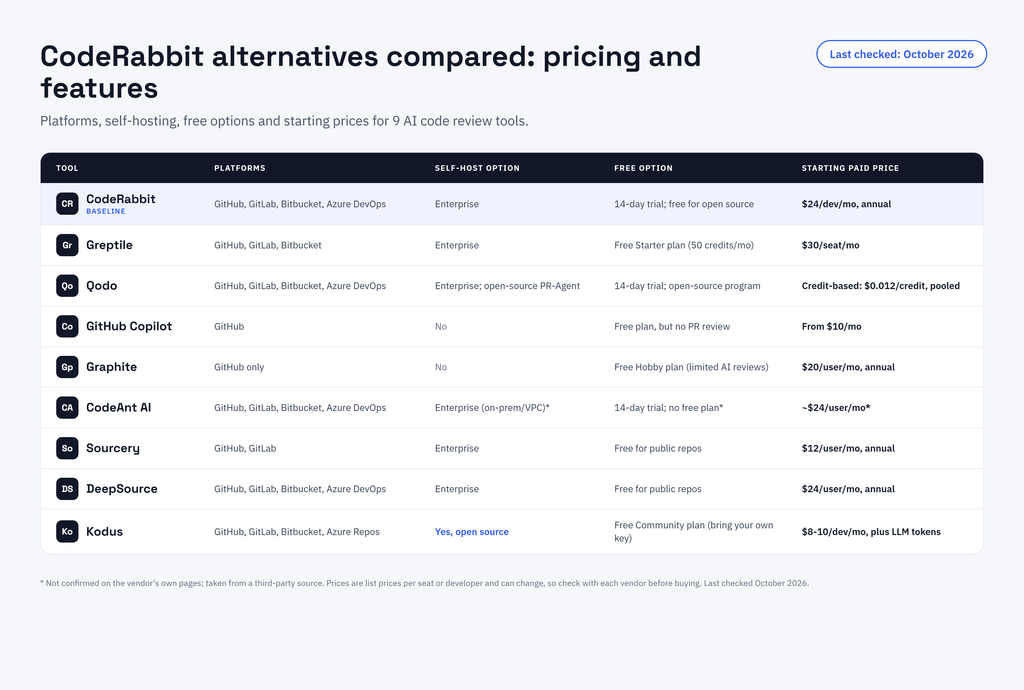
| Tool | Platforms | Self-host option | Free option | Starting paid price |
| CodeRabbit (baseline) | GitHub, GitLab, Bitbucket, Azure DevOps | Enterprise | 14-day trial, no card; free open-source plan | $24/dev/mo, billed annually |
| Greptile | GitHub, GitLab, Bitbucket (plus Gitea and Perforce on-prem) | Enterprise (Docker Compose, Helm, air-gapped) | Starter plan, free: 50 credits/mo, 1 active dev | $30/seat/mo (Pro) |
| Qodo | GitHub, GitLab, Bitbucket, Azure DevOps | Enterprise (single-tenant or on-prem); open-source PR-Agent (MIT) | No permanent free tier; 14-day trial and an open-source program | Credit-based, $0.012/credit pooled (see note 1) |
| GitHub Copilot | GitHub | No | Free plan exists, but PR review isn’t included | From $10/mo (Pro) |
| Graphite | GitHub only (GitHub Enterprise Server on Enterprise) | No | Hobby plan, free, with limited AI reviews | $20/user/mo (Starter), annual; $40 for Team |
| CodeAnt AI | GitHub, GitLab, Bitbucket, Azure DevOps | Enterprise (on-prem/VPC), third-party source only | 14-day trial, no card; no permanent free plan | ~$24/user/mo (Premium); $10 Basic is capped at 100 reviews |
| Sourcery | GitHub, GitLab | Enterprise | Free for public repos | 12/user/moannual(15 monthly) |
| DeepSource | GitHub, GitLab, Bitbucket, Azure DevOps | Enterprise (self-hosted and air-gapped) | Open Source plan, free for public repos only | $24/user/mo, billed yearly (Team) |
| Kodus | GitHub, GitLab, Bitbucket, Azure Repos (plus Forgejo) | Yes, open source (Community and Enterprise) | Community plan, free, unlimited PRs with your own API key | $10/dev/mo monthly or $8 annual, plus LLM tokens at provider cost |
Which CodeRabbit Alternative Fits Your Situation?
For beginners
Start with GitHub Copilot if you already use GitHub, or Sourcery’s free tier for Python. Both need little setup. Avoid self-hosted options until you are comfortable running your own infrastructure.
For students
Look for free tiers: Qodo’s Developer plan, Greptile’s Starter plan, or Sourcery on open-source repos. GitHub’s student offers may also cover Copilot, but check eligibility .
For small businesses
Cost per seat and predictability matter most. Compare Kodus, Sourcery and Copilot first. Remember that some tools charge only developers who open pull requests, so a 10-person team may pay for fewer seats .
For YouTube creators and indie builders
If you ship scripts, bots or small apps alongside your channel, a free or very cheap reviewer is enough. Start with a free tier. Paying per seat rarely makes sense for a solo project.
For WordPress developers
Plugin and theme work is mostly PHP, so test a tool on a real plugin repo before paying. DeepSource and CodeAnt AI add rule-based and security checks that suit PHP code, but confirm language support first .
How to Test a CodeRabbit Alternative in One Week
- Pick two tools from the list above and install both on a non-critical repo.
- Run the same 10 to 15 real pull requests through each, including at least two that you know contain a bug.
- Count useful comments versus ignored ones. Noise is the number one reason teams drop AI reviewers.
- Check the bill model. Estimate cost at your real PR volume, especially for credit-based tools.
- Check security and data terms if you work with client or regulated code.
Verdict: The Best CodeRabbit Alternative by Reader Type
- Solo developer: Start with a free tier (Qodo, Greptile Starter or Sourcery) or Copilot if you already pay for it.
- Small team (2-15 developers): Test Kodus for cost and control, or Copilot for zero setup. Try Greptile if bugs keep slipping through.
- Growing engineering team: Greptile for deeper context, or Graphite if slow, oversized PRs are the actual problem.
- Enterprise or regulated: Evaluate CodeAnt AI, Qodo Enterprise or Greptile Enterprise, and ask each vendor about self-hosting and data retention.
- Developer who wants full control: Kodus or self-hosted PR-Agent with your own model keys.
CodeRabbit remains a strong default, especially on GitHub and GitLab with a low-friction free tier for open source. Switch when your specific pain, whether cost, context, security or privacy, is clear.
FAQ
What is the best CodeRabbit alternative in 2026?
It depends on your priority. Greptile suits deep codebase context, Qodo suits review plus testing, GitHub Copilot suits teams already on GitHub, and Kodus suits open-source and bring-your-own-model setups. Trial two tools on real pull requests before choosing.
Is there a free alternative to CodeRabbit?
Yes, several. Greptile and Qodo list free plans with limited monthly credits, Sourcery is free for open-source repositories, and Kodus and PR-Agent are open source. Free tiers have caps, so check limits against your real pull request volume first.
Is GitHub Copilot a good CodeRabbit alternative?
It is a good starting point if you already pay for Copilot and use GitHub, since PR review is built in and needs no extra vendor. It supports GitHub only, and dedicated tools usually offer more review controls and platform choice.
Can I self-host an AI code review tool?
Yes. Kodus is open source with self-hosted runners, and PR-Agent can be self-hosted with your own LLM API keys. Greptile and Qodo list self-hosted options on enterprise plans. Self-hosting gives you data control but needs engineering time to maintain.
Why do teams leave CodeRabbit?
Common reasons include pricing predictability, noisy comments, limited whole-repo context, and the need for self-hosting or built-in security scanning. Many teams stay on CodeRabbit, so switch only if one of these problems is costing you time.